
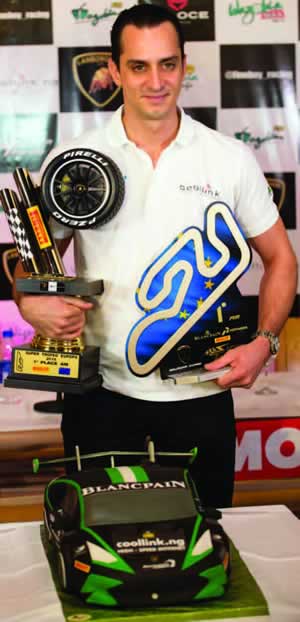
Shahin Nouri ditched his native Switzerland to represent and bring honour to Nigeria, the country of his wife, in motor sports. Nouri, who won the 2016 Lamborghini Blackpain Super Trofeo European title, in this interview with ’TANA AIYEJINA, talks about his love for his adopted country
The 2016 Lamborghini Blackpain Super Trofeo European title is your biggest win so far. How did you celebrate it?
My family was not with me in Spain, so I
celebrated with my team. We just went out and celebrated. When I came
back home, my kids had done drawings and they welcomed the champion with
a very lovely and touching reception. And I’m so happy that now that
I’m a father, I can enjoy being a champion with my kids.
Your feat brought honour to
Nigeria as the country’s anthem was sang for the first time ever on a
top-class motor racing podium. How did you feel on that occasion?
I really can’t describe how I felt that
day. I developed goose pimples when the Nigerian national anthem was
being played. It was indeed a proud moment for me as a Nigerian.
Have you been questioned about why you choose Nigeria ahead of your native Switzerland?
I have a lot of my Swiss friends that
were asking me, ‘why are you not representing Switzerland? You are
Swiss, so you should represent Switzerland.’ At the Euro 2016, we had a
lot of players from other countries representing Switzerland. So, why
can’t I do same for Nigeria? I’m very proud to represent this country,
I’m very proud to become a Nigerian. My children are growing up here in
Nigeria and I want to show to the world that Nigeria is a great place to
be. Right now, all I’m doing it to create some awareness for motor
sport in Nigeria. One of my dreams is to have a racing academy in
Nigeria in Lagos and maybe Abuja.
It’s a surprise to many that
you won because you hardly had time to train. How do you cope with
those who do more regular training than you?
(Cuts in) I think I can put this to my
dedication. When I cannot train in the car, I’m doing a lot of other
things to improve myself. Behind my computer in my living room, I have a
car seat with a wheel where I can just play with my Play Station and my
computer because that’s how you can actually learn the layout of the
track. So, I do a lot of this and I also do a lot of research watching YouTube
videos about tracks, and about onboard footage. I really take things
very seriously because I know that I don’t have so much time inside the
car. I also have the help of a racing coach and this helps so much
because my learning curve is much faster with my coach, Rupert Svendsen
Cook, than me alone. And my talent also contributes as well.
How ‘Nigerian’ are you?
I almost speak pidgin (English); I
understand everything in pidgin though I don’t speak Hausa, Yoruba or
Igbo yet. I need to learn about that. About the food, I eat egusi and my favourite is jollof (rice) and suya. I live here and I feel Nigerian; I’m hustling with you here.
How were you received when you first got into the country?
My wife is Nigerian. The first time I
came here was in 2003. Actually I was surprised. I was positively
surprised because I was expecting nothing good when I landed here but I
was surprised to discover that everything was fine here. This is such a
great nation. If I look back from 2003 to now, we’ve improved so much.
There’s so much focus on
football by the sports authorities. To what extent do you think this has
affected other sports like motor sports?
No doubt, football is the main thing in
Nigeria and it will always overshadow a lot of other sports but we are a
big nation and the motor sports community is also big. Now that we are
champions, there is a Nigerian as a motor sports champion, there will be
a great interest in motor sports. My dream is to create a young, black
Nigerian who will become a Formula One champion.
What role did your Nigerian wife, Tatiana, play in making you choose her country over yours, Switzerland?
First of all, she imported me here and I
have adopted this country because she loves it. If someone is bringing
you in and is not convinced about the country or about what they love,
you will never be convinced. So, it was easy for me to adopt Nigeria as
my country.
There’s a general impression that there’s so much risks attached to the sport…
(Cuts in) It’s true, whenever you race,
you have to sign, like a death warrant saying that if anything happens
to you, you are responsible and that you are at risk. But again you are
doing this on a proper track, proper facility with proper cars. We are
very well protected; it can look very risky from the outside but we’ve
really improved in terms of driver security.
Earlier this year, you were involved in an accident…
(Cuts in) Yes, I had an accident and I
didn’t score any point at the Silverstone event in the UK because I
crashed on the first lap.
How are you looking forward to 2017?
Next year is going to be associated with
another professional driver, to try and win the professional class as
well. And from there, go to the 24-hour LeMons Race and hopefully that
would be a dream to be on the podium and finish first in the LeMons
Race, because it’s the biggest race outside of Formula One.
How far do you think Nigerian drivers can go in motor sports, if given the necessary support?
Anyone can be a champion. If you look at
Latin America, you have Brazilian, Colombian, Venezuelan champions. Why
are we different? We can have a Nigerian champion. It’s not an issue if
he’s well groomed, trained and brought to the right places. Definitely
we can have a Nigerian champion. Nigeria is a very big country and I’m
sure we have motor sports talents in the country.
What do you do before and after a race?
Immediately before a race, I have to
focus on the race itself. So, I will do a lap in my head; think about
what I’m going to do next and on each turn, what I’m going to do and the
strategy as well. So, you’re doing the race on your head actually. And
right after the race, when I can celebrate, I celebrate. I call my wife
and send her a text telling her what happened and speak with the people I
love.
Will you encourage your kids to go into motor sports?
Yes. I will let them choose; I will not
push them into it. I think they are being inspired already; they see me
on TV, they see me racing, they see me winning and they’ve seen me
becoming champion. If they are happy to do it, I will support them.
Was there a point you wanted to quit the sport?
This season when I crashed at
Silverstone, I was really low and down because it was disappointing for
me to crash and not to score any point during the weekend but again I
had a lot of support from my wife and I think she’s really believing in
me and she told me not to quit. I was really down and I just put
everything together and came back. It’s not easy quitting the sport;
racing in a racing car is really addictive.
You started out as a basketball player and were even a champion. Why did you quit for motor sport?
In basketball, I was the Swiss junior
champion, then there was a lot of training and I had to go the
university, so I had to make a choice. The professional league in
Switzerland is good but you don’t earn a living. So, I had to focus on
my studies first.
Credit: Punch


No comments:
Post a Comment
Kindly drop your comments and also follow
Twitter: @opecareem
Instagram: @opecareem